http://www.npr.org/2011/09/19/140594124/u-s-government-opposes-cherokee-nations-decisionQuoteEmancipation And The Dawes Rolls
In 1866, the Cherokee Nation signed a treaty with the federal government that abolished slavery, except as a means of punishment, and granted former African-American slaves and their descendants "all the rights of native Cherokees." Blacks often had more rights on Indian reservations and territories in the South than they did in the Jim Crow South. Many of these former slaves were later listed by the U.S. government as "Freedmen" on an index known as the Dawes Rolls.
The Dawes Rolls lists the names of Indian citizens who applied for enrollment on the rolls of various tribes in Oklahoma around the turn of the 20th century. Today, the Cherokee Nation requires that a citizen have an Indian ancestor who appears on the Dawes Rolls. The document not only had categories for Indians who were mixed with white, but also categories for whites who married into the tribe, and blacks (Freedmen). The index was finalized on March 4, 1907, though updates would be made later.
let's get into the TEA ...
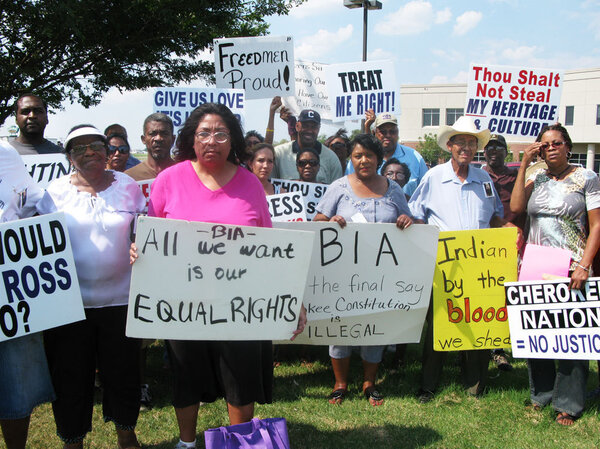
QuoteBlack Freedmen, who are descended from the slaves of Cherokee Indians, protest their expulsion on Sept. 2 outside a regional Bureau of Indian Affairs office in Muskogee, Okla. Marilyn Vann, in pink, is the president of the Descendants of Freedmen Association.
]
QuoteThe Cherokee Nation's Supreme Court ruled in late August that the black Freedmen could be stripped of their citizenship because they can't prove they have Indian blood. The tribe first voted in favor of this effort in 2007. While turnout for Cherokee elections tends to be low, more than 75 percent of all voters were in favor of the move.
Cherokee leaders say it's not a matter of race, but a simple matter of narrowing the definition of Indian down to those people who can prove they have Indian blood.
"This is not a club; you can't just claim to be Cherokee and show up and be included," says Cara Cowan Watts, a vocal member of the Cherokees' tribal council.
It happened with Cheyenne Arapaho as well, and many other tribes in Oklahoma, my cousin doesn't get her just dues and she's of a black father and "full-blooded" Indian mother.
you gotta WATCH girls and not believe the sob storys that they recite to you